Chanda Bhairava: Significance, Form, Worship & Spiritual Importance
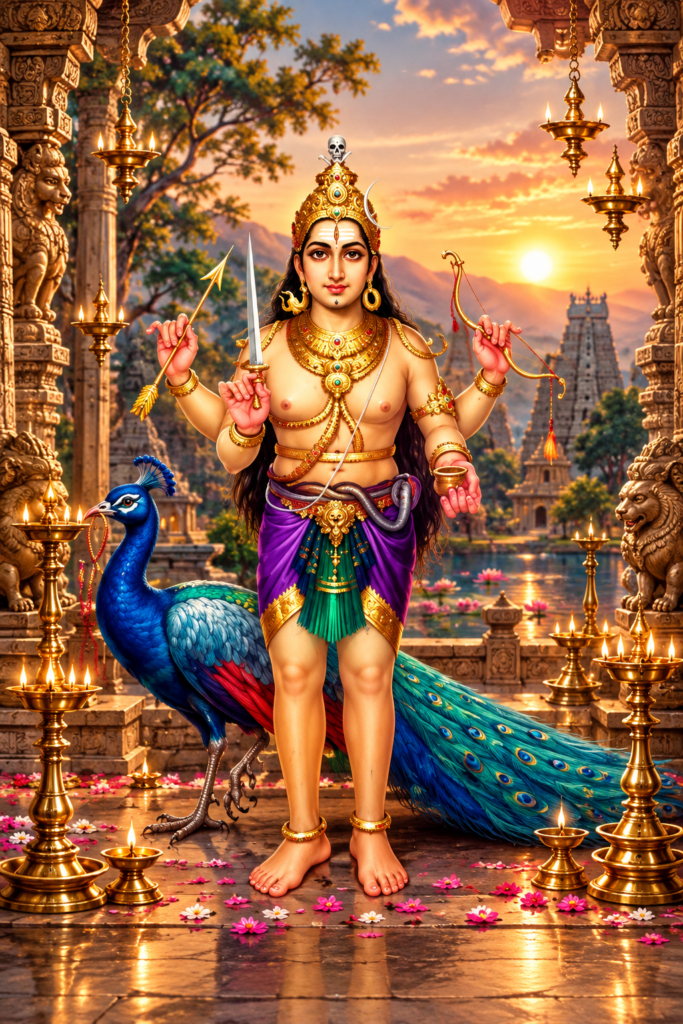
Chanda Bhairava is one of the eight principal manifestations of Bhairava traditionally known as the Ashta Bhairavas. Bhairava is a powerful form of Lord Shiva associated with protection, transformation, the dissolution of fear and the guardianship of sacred spaces.
Within the Ashta Bhairava tradition, Chanda Bhairava occupies a distinctive place. He is commonly described as the third among the eight Bhairavas and is traditionally associated with the southern direction. Several traditional descriptions portray him with four arms, carrying a bow, arrow, sword and bowl, and riding a peacock. His associated Shakti is commonly identified as Kaumari.
The Sanskrit name Chanda or Caṇḍa conveys a sense of fierceness, intensity or powerful energy. However, the fierce appearance of Bhairava should not be understood simply as anger or violence.
In Shaiva traditions, fierce forms can represent the Divine’s ability to confront obstacles, dissolve ignorance and protect spiritual order. For devotees and spiritual seekers, learning about Chanda Bhairava offers an opportunity to understand an important dimension of Shiva worship—one in which courage, discipline, awareness and transformation are emphasized.
This article explores Chanda Bhairava significance, form, worship, spiritual importance, Upasana and Sadhana, while distinguishing traditional beliefs from claims that cannot be established scientifically.
Who is Chanda Bhairava?
Chanda Bhairava is traditionally regarded as one of the Ashta Bhairava, the eight principal manifestations of Bhairava.
A commonly cited sequence is:
- Asitanga Bhairava
- Ruru Bhairava
- Chanda Bhairava
- Krodha Bhairava
- Unmatta Bhairava
- Kapala Bhairava
- Bhishana Bhairava
- Samhara Bhairava
The precise order, associations and iconographic details can differ between textual and regional traditions. Sources on the Ashta Bhairavas explicitly note that their names, ordering, directions and associated details are not completely uniform across all traditions.
Chanda Bhairava is therefore best understood within the broader theological framework of Bhairava rather than as an isolated deity. In this framework, the eight Bhairavas collectively represent different expressions of Shiva’s fierce and protective energy.
What is the Meaning of Chanda Bhairava?
The word Chanda comes from the Sanskrit Caṇḍa, a term associated with fierceness, intensity or powerful force. The word Bhairava refers to a formidable manifestation of Shiva. Bhairava is traditionally associated with protection, dissolution, time, transformation and the destruction of limiting forces.
Together, the name Chanda Bhairava can be understood as expressing an intense or fierce manifestation of Shiva’s protective and transformative principle.
The fierceness here has a deeper symbolic meaning. It can represent the willingness to confront:
- Fear
- Ignorance
- Attachment
- Pride
- Lack of discipline
- Destructive tendencies
- Spiritual obstacles
Rather than encouraging uncontrolled aggression, the symbolism can be understood as directing powerful energy toward self-mastery and righteous action.
Chanda Bhairava Ashta Bhairava Tradition
The Chanda Bhairava Ashta Bhairava connection is central to understanding his identity.
The eight Bhairavas are traditionally associated with the eight directions. A commonly cited arrangement places Chanda Bhairava in the South. Some traditional descriptions also associate him with a particular Shakti, vehicle and set of symbolic attributes.
The eight Bhairavas together create a symbolic protective framework around sacred space.
One traditional interpretation describes each Bhairava as guarding a direction while representing a distinct aspect of the broader Bhairava principle.
Thus, Chanda Bhairava is not separate from Shiva’s larger protective consciousness. He is understood as one expression of that Divine principle.
Chanda Bhairava Form and Iconography
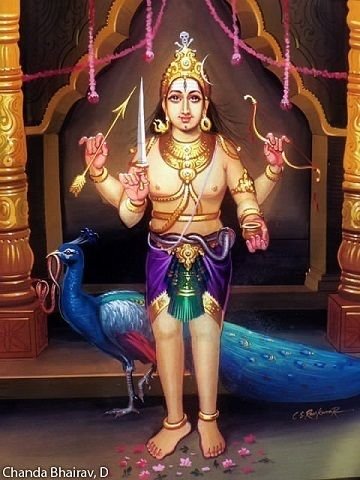
Understanding the Chanda Bhairava form is important because Hindu iconography communicates philosophical ideas through visual symbols.
Traditional descriptions commonly portray Chanda Bhairava with:
- Four arms
- A bow
- An arrow
- A sword
- A bowl or ritual vessel
- A peacock as the vehicle
- A youthful appearance
- A fierce yet controlled expression
- Three eyes
- Association with Goddess Kaumari
- Connection with the southern direction
A traditional Chanda Bhairava hymn describes him with a bow, arrow, sword and vessel and identifies the peacock as his vehicle.
Some sources describe his complexion differently, which illustrates an important point about Hindu iconography: descriptions can vary between scriptures, ritual manuals, temple traditions and regional practices.
Therefore, one should avoid treating a single modern image as the only universally correct representation.
The Four Attributes of Chanda Bhairava
The weapons and objects associated with Chanda Bhairava can also be understood symbolically.
Bow
The bow can represent focused intention.
A bow must be held steadily before the arrow can reach its target. In a spiritual context, this can inspire reflection on concentration and purposeful action.
Arrow
The arrow represents directed energy.
An arrow does not move toward multiple destinations at the same time. It symbolizes the value of focus.
For a spiritual seeker, this can become a reminder to avoid excessive distraction.
Sword
The sword is a recurring symbol in Bhairava and other Hindu iconography.
It can represent the cutting away of:
- Ignorance
- Confusion
- Attachment
- Ego
- False assumptions
The sword therefore does not necessarily represent physical violence. In spiritual symbolism, it can represent discernment and transformation.
Bowl or Vessel
The bowl or vessel is another feature found in Bhairava iconography.
Depending on the particular tradition and iconographic context, such objects can carry ritual, ascetic or symbolic meanings.
Together, these attributes portray a form of Shiva associated with focused power and transformation.
Chanda Bhairava Significance
The Chanda Bhairava significance can be explored at several levels.
1. Symbol of Courage
The fierce form of Bhairava can encourage devotees to face difficulties with awareness rather than fear.
This does not mean that worship automatically removes difficulties. Instead, the devotional symbolism can encourage an inner attitude of courage.
2. Transformation of Intense Emotions
The word Chanda suggests intensity.
From a spiritual perspective, intense emotions such as anger, fear or passion can either become destructive or be transformed into disciplined action.
Chanda Bhairava can therefore be contemplated as a symbol of controlled intensity.
3. Protection
Bhairava is traditionally associated with guardianship.
The Ashta Bhairavas are described as protectors of the eight directions in several traditions.
For devotees, this protective symbolism can provide a spiritual framework for cultivating awareness and responsibility.
4. Overcoming Inner Obstacles
Bhairava’s fierce imagery can be understood as confronting the internal obstacles that prevent spiritual growth.
These may include:
- Ego
- Fear
- Attachment
- Anger
- Laziness
- Confusion
- Lack of discipline
5. Awareness of Dharma
Fierce divine imagery does not necessarily promote aggression.
Instead, it can symbolize the strength required to uphold righteous conduct and resist destructive tendencies.
Chanda Bhairava Spiritual Importance
The Chanda Bhairava spiritual importance lies particularly in the symbolism of transformation.
Many spiritual traditions recognize that personal growth requires confronting uncomfortable aspects of oneself.
A seeker may need to examine:
- Why do I react with anger?
- What creates fear in my mind?
- Where does attachment control my decisions?
- Do I use my power responsibly?
- Can I remain disciplined when circumstances are difficult?
Chanda Bhairava’s fierce form can serve as a visual and devotional reminder of these questions.
The goal is not to cultivate fear.
It is to cultivate awareness, courage and inner discipline.
What are the Traditional Benefits of Chanda Bhairava Worship?
Devotional sources associate Bhairava worship with qualities such as courage, protection and spiritual strength. However, these should be understood as traditional religious beliefs, not guaranteed outcomes.
The commonly discussed spiritual benefits include:
Greater Courage
The symbolism of Bhairava can inspire devotees to face fear and difficulty with greater determination.
Inner Discipline
Regular Upasana can encourage consistency and self-control.
Awareness of Negative Tendencies
The fierce symbolism can encourage self-reflection about anger, ego, attachment and destructive habits.
Spiritual Focus
Mantra, prayer and meditation can provide a structured spiritual practice.
Sense of Protection
Traditional Bhairava worship is strongly associated with guardianship and protection of sacred space.
These are spiritual interpretations rather than scientifically established effects.
Chanda Bhairava and Vedic Astrology
For readers interested in Vedic astrology, it is important to distinguish astrological tradition from modern scientific astronomy.
Bhairava worship is sometimes incorporated into spiritual approaches to planetary difficulties, fear, obstacles or other concerns. However, there is no scientific evidence establishing that worshipping Chanda Bhairava will automatically alter planetary positions or guarantee a particular outcome.
Within traditional spiritual practice, a person may choose Bhairava Upasana as part of a broader devotional discipline.
If an astrologer recommends a specific spiritual practice, it should be understood as a traditional remedial approach rather than a scientifically guaranteed intervention.
For serious personal matters, spiritual practice should complement—not replace—appropriate practical, professional or medical guidance.
Learn more about the of Chanda Bhairava Special Rituals:
https://www.sahasrararituals.in/remedial-services/kalashtami-special-chanda-bhairava-maha-homam